Posts

Introduction to Counterpoint:

Image
Introduction to Counterpoint Lecture Notes: Counterpoint is referred to as voicings. Cantus firmus is a species of counterpoint that means fixed melody. The melody is made up of whole notes. Image from: https://music.stackexchange.com/questions/107570/what-is-considered-a-proper-cantus-firmus Pen Ultimate is what happens before the last note. It acts as a magnetic force to resolve to the very last note. Tendency Note - this is a note that must resolve. The Leading tone plays an important role in this. The 7th note  of the scale needs to resolve to the tonic  by raising it one-half step.  Image from: https://music.stackexchange.com/questions/100492/what-is-a-diatonic-tendency-tone Conjunct and Disjunct Conjunct are mostly in a stepwise motion.  Disjunct  are notes in a stepwise motion with alot of leaps and skips . A  skip  is another motions of moving to a  3rd , and a  leap  is an interval of a  4th  or more The shape ...
Lesson 10

Image
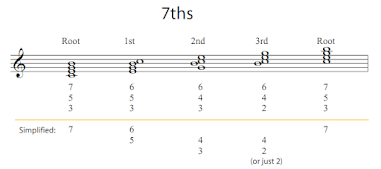
  Lesson 10: 7th Chords, Part 2 Lecture Notes: You will always find the root note of the 7th chord if you find the higher note of the 2nd interval ( dissonance ), only if the chord is not in "root position". The only figured bass that has a 7  in it is the root position . The rest of the inversions would have a 6 at the top followed by the other intervals of the bass at the bottom, or if simplified would have a 4 at the top for only the 2nd and 3rd inversions . Image from: https://music.stackexchange.com/questions/26837/chord-symbols-for-inversions-of-7th-chords In a lead sheet, you're always going to have a 7 above the chord no matter what type of Seventh Chord it is. Image from: https://www.harpspectrum.org/pedal/pool_short.shtml In lead sheets, another name for a half-diminished chord  ( ø )  is a minor 7th flat 5 ( m7 ♭ 5 ) Image from: https://hellomusictheory.com/learn/half-diminished-chords/ Inversions of 7th Chords The  Root position includes ...

Lesson 6

Image
  Lesson 6: Intervals Lecture Notes: The inversion of an interval adds up to 9 . For example, A major 2nd inverted is a minor 7th . (Also note that the quality of the interval flips. Example: major would be minor .) Image from: https://musictheorysite.wordpress.com/category/pitch/ The 1st, 4th, and 5th notes of the scale will always be a major 3rd. Every other note will be a minor third. With intervals, every identical line and space will be either a 3rd, 5th, or 7th. However, every unidentical line and space will become either a 2nd, 4th, 6th, or 8ve. Image from: https://hellomusictheory.com/learn/intervals/ There are  four  different ways to change the interval size:  If you raise the top note, you make the interval larger. If you lower the bottom note, you make the interval larger. If you lower the top note, you make the interval smaller. If you raise the bottom note, you make the interval smaller. Here's a YouTube video from David Bennet Piano. In this video, h...

Lesson 9

Image
     Lesson 9: 7th Chords, Part 1 Lecture Notes: Seventh Chords have an extra chord tone which is the 7th interval from the root. The two major 7ths on the white keys are C-B and F-E and the rest of the 7ths are minor. There are 5 main types of 7th chords: Major 7th, minor 7th, Dominant 7th, half diminished 7th, and full diminished 7th Image from: https://www.earmaster.com/music-theory-online/ch05/chapter-5-4.html Types of 7th Chords A  Major 7th Chord  includes of a Major triad and a Major 7th stacked. A  Dominant 7th Chord  has a Major triad and a minor 7th stacked. A  minor 7th chord  has a minor triad and a minor 7th stacked A  half-diminished 7th chord  has a diminished triad and a minor 7th stacked. A  full diminished 7th chord  includes a diminished triad and a diminished 7th stacked. Image from: https://www.musictheoryacademy.com/understanding-music/seventh-chords/ Here's a YouTube video from the YouTuber: "...

Lesson 8

Image
    Lesson 8: Inversions, Figured Bass, and Lead Sheets Lecture Notes: In finding a chord look for the lowest  note to find the root note . The difference between the root and the bass  is that the root is the foundation of the chord. On the other hand, the bass is the lowest note of a chord. There are three types of inversions of a chord: Root Position, 1st Inversion and 2nd Inversion. Inversions The root position is stacked in thirds and it has the rote note at the bottom. The 1st inversion will have the third (3rd) at the bottom as the bass followed by the rest of the chord above it. The 2nd inversion will have the fifth (5th) at the bottom as the bass followed by the rest of the chord above it. Image from: https://dictionary.onmusic.org/terms/2943-root_position Figured Bass Figured Bass is finding what inversion the chord is in based on the intervals above the bass. Always remember that 5/3 is  Root Position, 6/3 is 1st inversion, and 6/4 is 2nd inve...

Lesson 7

Image
   Lesson 7: Triads Lecture Notes: A Major Triad is the Root note , Major 3rd , and Perfect 5th combined. A Minor Triad is the Root note , Minor 3rd , and Perfect 5th combined. Major and Minor Triads refer to the 3rd interval quality. Image from: https://www.earmaster.com/music-theory-online/ch05/chapter-5-2.html Augmented Triads are the Root note , Major 3rd , and Augmented 5th . Diminished Triads are the Root note , Minor 3rd , and a Diminished 5th . Augmented and Diminished Triads refer to the 5th interval quality. Image from: https://www.audiolabs-erlangen.de/resources/MIR/FMP/C5/C5S1_Chords.html The relative natural minor scale is the major scale starting on the 6th degree as the 1st note.  ( I )   Image from: http://www.cyberflotsam.com/Music_NaturalMinor1.htm Here's a YouTube video from the YouTuber: "David E. Farrell". In this video, he educates you on all the different qualities of Triads and what intervals make them work. The types of triads that he intr...

Lesson 4

Image
   Lesson 4: Minor Scales and Minor Keys Lecture Notes: The order of sharps (#'s) or flats ( ♭'s) in a key signature for any minor scale is the same as its relative major scale. (Example: A minor and C major has the same signature) Image from: https://chordprogressionblog.wordpress.com/2016/11/23/music-theory-minor-and-relative-keys/ The major pentatonic and the minor pentatonic are the same. In order to find the relative minor scale from a major, you would have to look for the 6th degree of the major scale.  Image from: https://www.teoria.com/en/tutorials/scales/03-relative.php In order to find the relative major scale from a minor scale, you would have to look for the 3rd degree (minor 3rd) of the minor scale. Here's a YouTube video from Joel Dave. In this video, he helps you better understand how to find the relative minor using a major scale and how to find the relative major using a minor scale. Natural Minor Scale Natural minor scales derive from their relative majo...